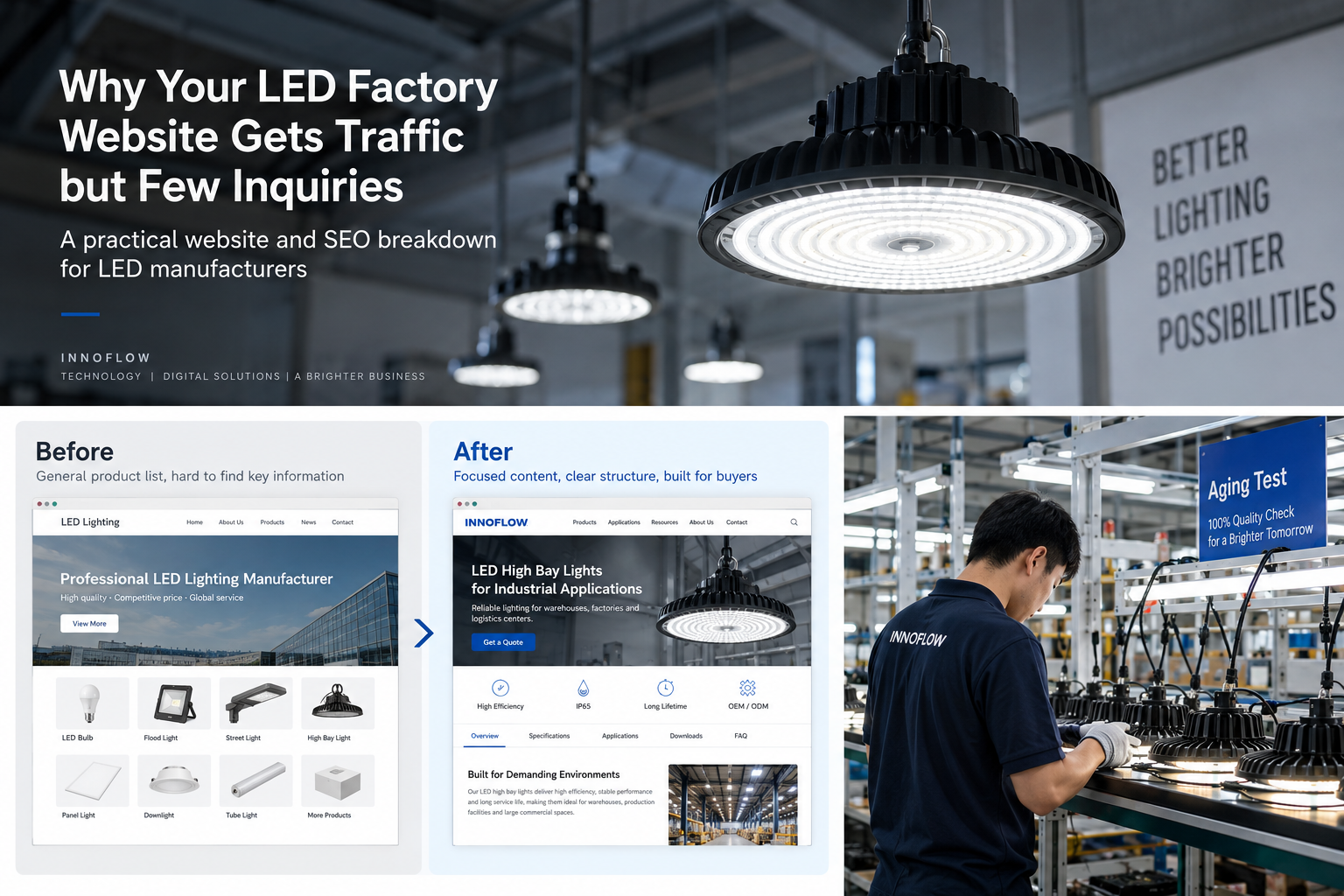
A factory website can look perfectly fine and still generate very few inquiries.
We have seen this more than once.
The company has a good product range. The factory is established. Certifications are available. The sales team attends exhibitions and already exports to several countries.
The website, however, receives visitors without turning many of them into conversations.
At first, this looks like an SEO problem.
Sometimes it is.
But quite often, traffic is only part of the problem.
The bigger issue is what happens after a buyer arrives on the website.
1. The homepage is trying to sell everything
A typical LED manufacturer's homepage may contain:
LED bulbs, flood lights, street lights, high bay lights, panel lights, downlights, OEM services, company history, certificates, factory photos and ten different product banners.
Everything is there.
But a buyer arriving from Google is rarely looking for “everything.”
Someone searching for an industrial high bay supplier may care about:
- wattage and lumen output
- beam angle
- IP rating
- operating temperature
- driver options
- certifications
- MOQ
- OEM availability
- lead time
If the visitor has to browse through three menus and download a catalogue before finding this information, some will simply leave.
This is one reason we prefer building pages around buyer intent, rather than putting the entire product catalogue behind one generic “Products” page.
For example:
/industrial-led-high-bay/
is usually much more useful than:
/products/
The first page has a clear job.
The second one is just a directory.
2. Stop treating SEO as a list of keywords
One common approach to SEO is:
LED manufacturer
LED supplier
LED lighting factory
LED light China
These keywords are relevant, but they are also broad and highly competitive.
More importantly, they tell us very little about what the buyer actually needs.
We would rather build content around searches closer to a purchasing decision.
For example:
LED high bay lights for warehouses
IP65 LED flood light manufacturer
OEM LED street light supplier
LED lighting supplier for commercial projects
How to choose LED high bay wattage for a warehouse
LED lighting OEM vs ODM
The traffic volume of an individual topic may be smaller.
That is not necessarily a problem.
For a B2B manufacturer, 100 visits from purchasing managers, distributors and project contractors can be more useful than 5,000 visits from people who will never request a quotation.
SEO traffic is not the final KPI.
Qualified inquiries are.
3. Product pages should answer purchasing questions
This is where many industrial websites lose potential customers.
A product page contains a nice photo, a model number and perhaps five specifications.
Then:
Contact Us.
That is not enough information for many professional buyers.
Before contacting a new supplier, a buyer is already doing some basic qualification.
They want to know whether the supplier is worth contacting.
A stronger product page might include:
Technical information
Power
Input voltage
Luminous efficiency
CCT
CRI
Beam angle
IP rating
Operating temperature
Driver
Material
Expected lifetime
Commercial information
MOQ
Typical lead time
OEM/ODM availability
Custom packaging
Logo customization
Sample availability
Compliance information
CE
RoHS
CB
UL/ETL where applicable
Test reports
And, importantly:
real product and factory photographs.
Not every page needs beautiful marketing photography.
Sometimes a photograph of the assembly line, aging test, integrating sphere test or packaging area tells a buyer much more than another polished rendering.
4. We changed the way the website was structured
In one of our previous website projects, the original structure followed the company's internal product categories.
That sounds logical.
But customers do not necessarily search the way a factory organizes its catalogue.
So instead of thinking only:
What products does the company sell?
we started with another question:
What would a potential customer type into Google before contacting this company?
That changed the structure.
Rather than relying on a small number of broad product pages, we separated the site into several layers:
Category pages ↓ Product / application pages ↓ Technical content ↓ FAQ and purchasing information ↓ Inquiry
This also gave us more useful pages for SEO.
A technical article could link naturally to the relevant product category.
The product category could answer commercial questions.
And the inquiry form was available when the visitor was ready.
No complicated funnel.
Just fewer dead ends.
5. The inquiry form was also part of the problem
This is easy to overlook.
We have seen B2B websites asking visitors to complete:
Company Name
First Name
Last Name
Country
Address
Telephone
Job Title
Industry
Company Size
Product
Quantity
Message
before they can send an inquiry.
That may be useful for the sales department.
It is not necessarily useful for the customer.
For an initial conversation, we normally prefer something closer to:
Name
Email / WhatsApp
Product interested in
Message
More detailed qualification can happen afterwards.
The goal of the first form is not to complete the entire sales process.
It is to start the conversation.
6. A catalogue is not a content strategy
PDF catalogues are still important in the electrical and lighting industry.
We use them too.
But a catalogue and a website serve different purposes.
A catalogue is useful when the customer already knows the company.
SEO content helps the customer discover the company.
That means an LED manufacturer can build useful pages around actual purchasing questions:
- How many watts of LED high bay lighting does a warehouse need?
- 4000K vs 5000K for industrial lighting
- IP65 vs IP66 lighting
- How to evaluate an LED driver
- What information is needed for an OEM lighting quotation?
- Common LED lighting certifications for export markets
- What affects the lifetime of an industrial LED fixture?
These topics are not written just to fill a blog.
Each one should connect to a real product, application or purchasing decision.
That distinction matters.
7. What we measure after launch
Ranking is useful, but we do not look at ranking alone.
For a B2B website, we are more interested in the path between:
Search → Page → Product → Inquiry
Some practical questions are:
- Which pages bring potential buyers?
- Which product pages receive traffic but no inquiries?
- Where do visitors leave?
- Which countries are generating relevant traffic?
- Which articles lead visitors into product pages?
- Which inquiry buttons are actually being used?
A page ranking on Google is good.
A page ranking on Google and helping the sales team start conversations is much better.
The takeaway
If an LED factory website is receiving little business from Google, adding another 50 blog posts is not always the answer.
Start with the basics.
Look at what buyers are searching for.
Look at the information they need before contacting a supplier.
Look at whether the product pages actually answer those questions.
And then look at how easily a visitor can move from:
“I found this company.”
to:
“I think they may be able to supply what we need.”
to:
“I'll send them an inquiry.”
That is the part of SEO that is sometimes forgotten.
Search engines bring people to the door.
The website still has to do the rest.